

Designing for the Remote Worker, the Bleisure Traveler, and the Always-On Guest
- Isura Randika Abeysinghe
- May 18
- 6 min read

Lighting Strategies and Design Insights for Residential and Hospitality Spaces Shaped by New Remote Work and Bleisure Travel Lifestyle.

Remote work has evolved from a temporary operational shift into a permanent lifestyle category — and with it comes an entirely new design brief for residential and hospitality interiors.
For designers, developers, and hotel operators, this shift represents far more than the addition of a desk and ergonomic chair. The real differentiator now lies in how environments feel over prolonged periods of occupation. Increasingly, lighting has become one of the most powerful yet underestimated tools in shaping guest performance, emotional wellbeing, productivity, natural sleep-wake rhythms, and perceived luxury.
Research now shows that many residential workspaces operate at dramatically insufficient lighting levels compared to commercial environments, contributing to eye strain, fatigue, headaches, biorhythm disruption, and reduced cognitive performance. Meanwhile, remote workers increasingly report spending extended hours in poorly lit environments that negatively impact both productivity and wellbeing.
From “Home Office” to Performance Environment
For years, hospitality and residential lighting focused primarily on atmosphere and aesthetics. Today, spaces must also support modern user needs such as endurance, adaptability, digital presence, and psychological recovery.
Residential environments designed for remote-work lifestyles may now function simultaneously as:
Executive office
Video conferencing studio
Wellness retreat
Social lounge
Sleeping sanctuary
The challenge for designers is that these modes often require entirely different lighting conditions.

A guest taking a board meeting at 10 a.m. needs alertness-enhancing illumination, glare control, and flattering facial lighting for video calls. The same guest, two hours later, may want subdued layered lighting for relaxation, followed by warm circadian lighting in the evening to support sleep recovery.
This is why static lighting strategies are becoming obsolete in premium hospitality and residential projects.
The future belongs to adaptive, layered, human-centric lighting ecosystems.
The Most Overlooked Pain Point: Visual Fatigue
One of the defining challenges of today’s remote-work lifestyle is the growing epidemic of visual exhaustion.
Users consistently report:
Eye strain
Migraines
“Zoom fatigue”
Poor sleep quality
Lack of energy in windowless work areas
Emotional fatigue caused by flat or clinical environments
Many remote workers now spend 10–13 hours daily on screens. Yet most residences and hospitality suites were never designed for this intensity of visual occupation.
This is where luxury lighting design must evolve from decorative enhancement into physiological infrastructure.
Research led over several decades by Dr. Jennifer Veitch, Senior Research Officer at the National Research Council of Canada, explored how indoor lighting conditions influence employee wellbeing, cognitive performance, stress levels, and overall workplace engagement. Incorporating environmental psychology and sensory psychophysics, her studies demonstrated that occupants who are given greater control over their lighting environment report improved mood, sharper cognitive focus, and stronger engagement with their work.
This insight is especially important in the context of luxury residential and hospitality projects designed for remote workers, business travelers, and bleisure guests. Today’s remote workforce is not simply looking for visually impressive environments; they are seeking spaces that help them feel energized during periods of focus and emotionally restored at the end of the day.
Human-Centric Lighting Is Becoming the New Luxury Standard
High-net-worth travelers increasingly prioritize wellbeing, recovery, and performance optimization. This is precisely why human-centric lighting (HCL) is rapidly moving from niche wellness concept to mainstream luxury expectation.
Human-centric lighting mimics the changing color temperature and intensity of daylight throughout the day:
Cooler, brighter light during work hours to support alertness
Warmer, dimmer light in the evening to encourage melatonin production and relaxation
Research demonstrates that tunable lighting aligned with circadian rhythms can improve cognitive performance, mood, and sleep quality.
What makes this especially relevant for hospitality is that business travelers often operate across time zones while simultaneously maintaining demanding schedules.
Lighting can now actively help guests recover from jet lag.
This represents an enormous opportunity for premium hospitality brands.
Hospitality Is Quietly Leading the Innovation

Some of the world’s most forward-thinking hospitality brands already understand that remote work is fundamentally reshaping guest expectations.
The Dutch hospitality concept Zoku is one of the strongest examples. Rather than treating the workspace as an afterthought, Zoku designed entire loft environments around hybrid living and working. Their lighting strategy uses dimmable layered illumination, flexible work zones, and carefully controlled transitions between productivity and rest.
What makes the concept successful is not merely functionality — it is psychological zoning.
Lighting becomes the invisible architecture separating “work mode” from “living mode.”
Similarly, The Hoxton’s “Working From_” concept transformed hospitality coworking spaces into environments that feel residential rather than corporate. Warm layered lighting, decorative pendants, daylight harvesting, and intimate material palettes create emotional comfort while still supporting productivity.
This is a critical lesson for designers:
Luxury remote-work environments should never feel like offices.
They should feel like emotionally restorative spaces capable of supporting high performance.
The Rise of the “Camera-Ready Interior”
One of the most fascinating evolutions in luxury residential and hospitality design is the emergence of the “broadcast-ready” room.
For executives, founders, consultants, and high-net-worth individuals, video presence has become an extension of personal brand identity.
Poor lighting now communicates a lack of sophistication.

Today’s remote professional expects:
Flattering facial lighting
Minimal glare
Architectural depth on camera
Warm, high-CRI material rendering
Professional visual backgrounds
This has led to a quiet integration of cinematic lighting principles into residential interiors.
Many premium projects are now embedding:
Indirect linear lighting
Soft vertical facial illumination
Recessed architectural wash lighting
Hidden backlighting within millwork
Integrated video-conference lighting systems
Rather than relying on visible ring lights or temporary equipment, luxury interiors are beginning to conceal broadcast-quality lighting directly within architecture.
The result is subtle but transformative:
The guest appears healthier, sharper, and more authoritative on screen.
For hospitality brands serving business travelers, this can become a major competitive advantage.
The Future of Luxury Is Adaptive, Not Static
Perhaps the biggest shift occurring in lighting design is the transition from fixed environments to responsive environments.
Guests increasingly expect spaces that adapt intuitively to different emotional and functional states.
The most advanced systems now allow lighting scenes such as:
Focus mode
Relaxation mode
Jet lag recovery mode
Evening wind-down mode
Presentation mode
Entertainment mode
These transitions may seem technical, but their emotional impact is enormous.
A room that subtly shifts color temperature, brightness, and atmosphere throughout the day creates a feeling of care — almost hospitality at a neurological level.
This is especially important in smaller luxury residences and suites where one room must support multiple functions.
Lighting becomes the tool that allows a space to transform psychologically without physically changing.
Biophilic Illumination: Recreating Nature Indoors
Another major trend shaping luxury work-from-home environments is the fusion of lighting and biophilic design.
Natural light remains one of the strongest contributors to wellbeing and productivity. Studies associate access to daylight with increased creativity, improved mood, and reduced eye strain.
However, many urban luxury residences, airport lounges, and hospitality suites lack adequate daylight exposure.
This has accelerated interest in:
Artificial skylights
Virtual windows
Circadian lighting systems
Dynamic daylight simulation

Emerging virtual skylight systems and digital daylight technologies are now creating remarkably convincing simulations of natural sunlight, sky conditions, and outdoor views.
What was once futuristic is rapidly becoming commercially viable for luxury wellness hospitality, branded residences, private lounges, and ultra-premium work suites.
For designers, this opens an entirely new design language:
Light no longer merely illuminates architecture — it can simulate geography, climate, and time itself.
Why Layered Lighting Matters More Than Ever
One of the most damaging mistakes in remote-work-focused interiors remains over-reliance on uniform overhead lighting.
The best-performing luxury spaces consistently rely on layered illumination:
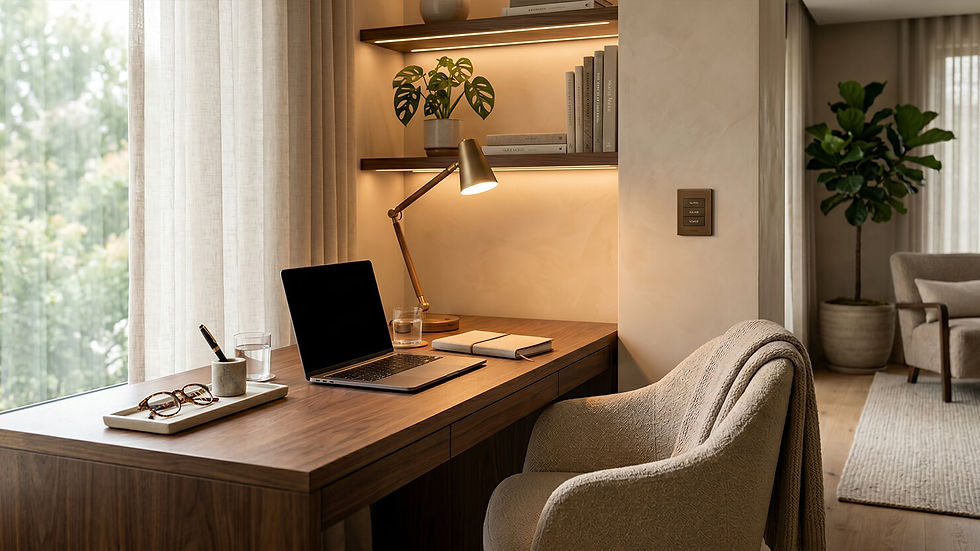
Ambient lighting for overall comfort
Task lighting for focused work
Accent lighting for emotional warmth and spatial depth

This layered strategy creates visual hierarchy, reduces fatigue, and preserves the residential character of the environment.
Importantly, it also supports emotional transitions throughout the day.
A workspace should not feel identical at 8 a.m., 2 p.m., and 10 p.m.
The finest hospitality projects increasingly understand that luxury is not about brightness.
It is about control, nuance, atmosphere, and ultimately how a space makes the guest feel over extended periods of occupation. The most memorable environments are those that quietly reduce stress, support focus, and create an emotional sense of ease without the user ever consciously noticing why.
The New Benchmark for Luxury Hospitality and Residential Design
Ultimately, the remote-work revolution is reshaping the meaning of premium interior experience.
Luxury is no longer defined solely by marble, square footage, or craftsmanship.
Increasingly, true luxury means:
Better sleep
Reduced fatigue
Stronger cognitive performance
Emotional comfort
Seamless transitions between work and life
Spaces that actively support wellbeing
Lighting sits at the center of all of this.

For designers and developers, the opportunity is extraordinary.
Those who continue treating lighting as a finishing layer will struggle to meet the expectations of the next generation of high-value guests and residents.
But those who understand lighting as a wellness tool, productivity tool, psychological tool, and hospitality tool will define the next era of luxury interiors.
The future of premium design is not simply illuminated.
It is intelligently, emotionally, and biologically tuned to human experience.


Comments